
Exploring language
Tips for best supporting language development in an early years environment.
Contents on this page
Why exploring language is important
Children’s speech develops from babble, to words, to simple sentences through hundreds of hours of interactions with adults. Studies show that once babies begin to understand words their vocabulary increases quickly:
- by age 1, children recognise about 50 words
- by age 3, children recognise about 1,000 words
- by age 5, children recognise about 10,000 words
Having a large vocabulary helps children learn more. Words allow them to make sense of the world around them.
Communication and language is a EYFS prime area which means that it’s one of the important building blocks for all the other areas. If it’s not developed early it’s difficult to achieve later.
Children’s language skills are connected to their overall development and can predict their educational success. As speaking and listening develops, children build foundations for literacy, for making sense of visual and verbal signs and ultimately for reading and writing.
Children from more disadvantaged backgrounds may have fewer chances to develop their vocabulary. However, research shows that lots can be done in the early years to avoid inequalities in children’s language development.
Removing this inequality should be a priority for you. You can work towards this by providing a language rich environment full of stories, rhymes, songs and play with words that are of interest to children. Children can make good progress with early language development with the right support.
There are also lots of benefits from learning more than one language (including sign language) for example, understanding of grammar, spelling, creativity and story-telling skills.
Video
In this video, an early years expert explains the importance of exploring language in the early years foundation stage framework. There are also some tips on how to support children in this area.
Transcript
Transcript
Language development in the first years of life is critical to later educational success. Language skills are time-sensitive, which means that they’re really difficult to acquire later on.
As practitioners, we’re in a position to make a big difference at this crucial stage by providing a rich language environment and by being attentive conversation partners.
Language development is best supported in a playful environment full of stories and songs, rhymes, signs, talk, and imaginative play.
So one of the things we’re going to talk about is actually just trying to find time to talk with children in everyday experiences and routines.
I’m just wondering whether you’ve got some examples that we could explore around that.
When I was working in the two-year-old room, I think one of the things we’ve been really thinking about and reflecting on is ensuring that the routine has a pace but isn’t so quick that the children are rushed through it, because during those daily routines and those everyday activities are a really good opportunity for them to explore and talk, and us to talk together with them, and they’re really able to make connections with their home routines. I think it’s really important for children to have real reasons to talk and have lots of opportunities for spontaneous conversations, but also perhaps more structured times with adults to support their communication and language. Have you got any examples that you use in your setting?
When we finish the first bit of the morning, we come back and sit down in small groups, which is we call review time. And the children, they talk about what they have been learning in that morning, and they share with their peers as well. And they ask what they’ve been and what they like, what they were doing, and who were they playing, which is very important for children who doesn’t want to talk that a lot. And they share experience as well.
I think that really predictable routine of review time, because it happens every day, it gives confidence for those children who might not initially be able to express themselves verbally. And we use lots of visual prompts to support the children. Photographs of what they’ve been doing that morning. Might be real things that they bring, a model that they’ve made.
And they’re the experts because they’re the ones who’ve been doing that learning in the morning, and it really supports those children who may feel a little bit more shy in a group, or just might not yet have the vocabulary, or they might be learning it in a new language from their home language.
A really great way of introducing children to new words and vocabulary is using really great books and songs and rhymes.
Do you have any experience of using great things in your nursery school? We use songs and stories really regularly with the children as we do all the way through the nursery.
That repetition really supports the children to consolidate their learning and gives them that sense of understanding and feeling part of the group. With the two-year-olds particularly, lots of the action rhymes and nursery rhymes which have actions that go with them that you can use your whole body to explore, really support children to sort of understand the different parts of the word and to really tune into the sounds within the words, as well as that sense of joy of using your voice to express yourself and using your whole body to express yourself.
The best thing of all is enjoying conversations with children and encouraging children to talk to each other.
If a child knows you like talking and listening to them, they will want to talk and listen to you. Children will learn so much language in their earliest years, and this unlocks new learning in all areas of their life.
Exploring language with young learners is so important, and as practitioners, we’re in a very powerful position to make a big difference by providing a rich language environment.
Play is often the best way for children to use and explore the words that they’re learning in meaningful contexts.
What the EYFS framework says
Through conversation, story-telling and role play, where children share their ideas with support and modelling from their teacher, and sensitive questioning that invites them to elaborate, children become comfortable using a rich range of vocabulary and language structures.
Further information can be found in the statutory framework for the early years foundation stage.
What this means in practice
Children develop strong language skills when they are involved in playful, language-rich environments with opportunities to learn new words. Hands-on experiences encourage learning and provide a context for new words to be explored. For example, it’s easier for children to learn vegetable names when they are touching or tasting them.
Songs and rhymes offer fun ways to explore the sounds and patterns of words. Poems with actions and repetition help children listen to the structure of spoken language and explore new words.
Reading stories aloud and sharing books supports children to develop language and understand new concepts. Encouraging children to notice pictures and understand words, will strengthen their language skills and widen their vocabulary.
Non-fiction and high-quality texts such as story books, encourage children to make sense of the world around them using language. Encouraging talk when sharing books is an excellent way to support communication and language.
Children extend language with pretend play and acting out stories. By offering props and ideas you can deepen the learning. This may include imaginative play with small world resources such as dolls’ houses, farms or garages, open ended materials (those which can be used in more than one way) such as blocks or loose parts. You can encourage language development through creativity and problem solving during activities like:
- painting
- exploring
- observing nature
- music
Suggested activities
Story scribing
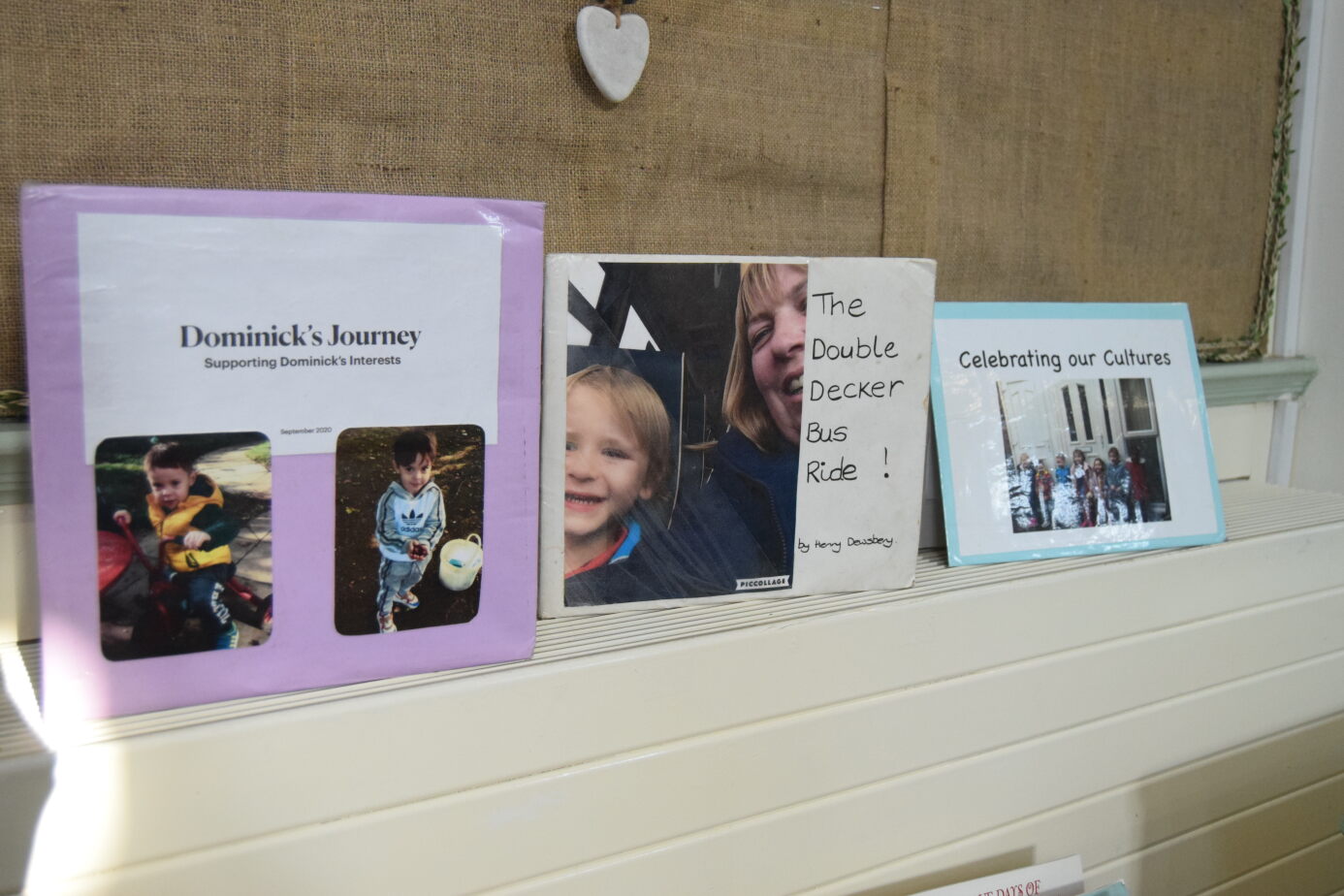
Children are born communicators and often practice their developing language skills by engaging in story-telling, through role play, small world and made-up games.
You can encourage and support this exploration of early language by scaffolding children’s learning and writing down exactly what children say, in the form of story books, for them to enjoy over and over again. Young children love repetition and this type of activity will offer important opportunities for them to feel their voice has been heard.
For younger children story scribing may involve creating picture books of recent experiences, such as trips to the park or birthday parties, with key people and phrases included. These can be created using pre-made photo albums or simply by stringing together printed photographs. Often these can be contributed to by parents or carers and allow practitioners to gain a deeper understanding of a child’s home learning environment, including key vocabulary.
For older children, you can transcribe more elaborate and creative experiences such as children’s own interpretations of familiar stories, superhero play adventures or the ‘rules’ of a game the children have invented. Again, these can be made into a paper story book or displayed as storyboards for children to return to and follow.
Often children enjoy re-enacting these stories with practitioners and their peers, so a simple marked out ‘performance area’ or cardboard box ‘theatre’ may support children to share and enjoy these ‘stories’ further.
How the activity links to the other areas of learning
This activity links to children’s personal, social and emotional development and literacy, as they share stories and interact with others. It also provides opportunities for children to engage in expressive arts and design.
Sensitively narrating play
Children learn language when it is introduced to them sensitively, at a time it is relevant to them, in manageable amounts, and with plenty of time to process. One way of encouraging children’s understanding, and later use, of verbal language is to offer examples to them as they play. Narrating children’s play in these ways:
Commenting, or describing what children are doing, as they are doing it. Using simple, repetitive phrases and pausing in between. This is particularly helpful for complex concepts, for example things you cannot hold, like ‘red’, ‘bigger’ or ‘tomorrow’ and should never feel like you are overwhelming the child with words without meaning.
For example, during block play: “your tower is getting taller and taller”.
Expanding on what children say as you reply, adding one or 2 words. This shows children you are interested and supports them to begin linking words and ideas in play. It can also be helpful to remember that, if you ask a child one question and they are unable to reply, you may demonstrate responding by offering 4 comments.
For example, ‘what have you got?’ (question) Pause ‘It’s a car’, ‘It’s a red car’, ‘It’s a red, fast car’, ‘It goes vrroomm!’ (comments).
Recasting, or modelling, back what the child says, in the right form, but without openly correcting them. For example, in the role play area, if a child said ‘the baby sleeped in the bed’ you might say ‘oh, shhh, the baby’s sleeping in the bed’ to support the understanding of the complex relationships between grammar and vocabulary.
Pausing, allowing children extra time to respond, before speaking again. This supports language use as children’s brains develop and fine-tune those important connections which enable them to receive and understand messages, before forming and expressing their response.
For example, when talking to a child about their play, say something but then wait several seconds (count to 7 in your head) and keep looking at them so that they know you are interested and listening for their response.
Be flexible and responsive to different learning situations and interact in an authentic way having been invited into a child’s play. This will help to make sure that thinking is not interrupted and there is a sense of equality between you and the child.
What other nurseries and childminders are doing
“Central to our practice is establishing a shared context to start the conversational journey. Planning learning experiences through the ‘lens of accessibility’ with lots of ways for English as an additional language children to attend, participate and communicate without needing words. Visual signs, simple language and familiar routines all help. Children develop the motivation of being valued members of the group and can share their knowledge and interests with us, even if we do not share their language. Familiar objects to model telling a story create a point of shared understanding and new vocabulary can be introduced. Natural, playful repetition found in all good story telling supports learners to thrive”.
Jet, St Pauls Nursery School and Children’s Centre, Bristol
Summary
- Language development in the first years of life is important to later educational success.
- Communication and language is a prime area in the EYFS and is difficult for children to develop later on.
- Language development is best supported in a playful language environment full of stories, songs, rhymes, signs, talk and imaginative play.
- You are important in narrowing the word gap and supporting all children to make good progress.
- You can be a skilled communication partner with children to support their language development.
Next steps
- Consider how having an understanding of typical communication and language development stages could further improve your practice.
- Review how you meet all children’s communication needs, including non-verbal learners.
- Strengthen partnerships with parents and carers, and professionals to support children’s speech, language and communication.
- Review your curriculum to ensure you cover the requirements in the EYFS for this area of learning.